Stanford PhD. Two-time founder. Building AI that works in the physical world.
I build learning systems for machines that move. My neural network vehicle models drove a full-scale race car at the limits of friction and were published in Science Robotics. In industry at Motional, my planning and control work spanned research to full production, from machine learning simulation to planning and control techniques deployed across the fleet. Today I am co-founder and CTO of Tamarin AI and founder of BUILD617.
Published
First author in Science Robotics. Cited 440+ times.
Patents
Five in autonomous vehicle planning and control.
PhD
Stanford, 2021. Learning-based control at the limits of handling.
Fellowships
NSF Graduate Research Fellow. Stanford Graduate Fellow.
Undergrad
MIT mechanical engineering, 5.0 out of 5.0.
Tested
Thunderhill Raceway to the Arctic Circle to public roads.
A toy version of multimodal contingency planning for autonomous vehicles, running live.
Surface
Dry asphalt
Grip, μ
0.95
Speed
0 mph
Cornering
0.00 g
Lap
0.0 s
Friction circle
IceDry asphalt
Nominal plan, long horizon
Contingency plan, short horizon
The car plans its speed from the grip it has. Slide the surface toward ice and the friction circle shrinks with it. On the real cars, a neural network learned the surface from how the car moved. Nobody gave it the friction coefficient.
Physical AI
Machine learning for high-performance systems, where a wrong prediction puts a vehicle off the track or into a collision.
Six years in Stanford's Dynamic Design Lab and two at Motional on one problem: learned planning and control that stays safe at the edge of what physics allows. The published results below all ran on full-scale cars.
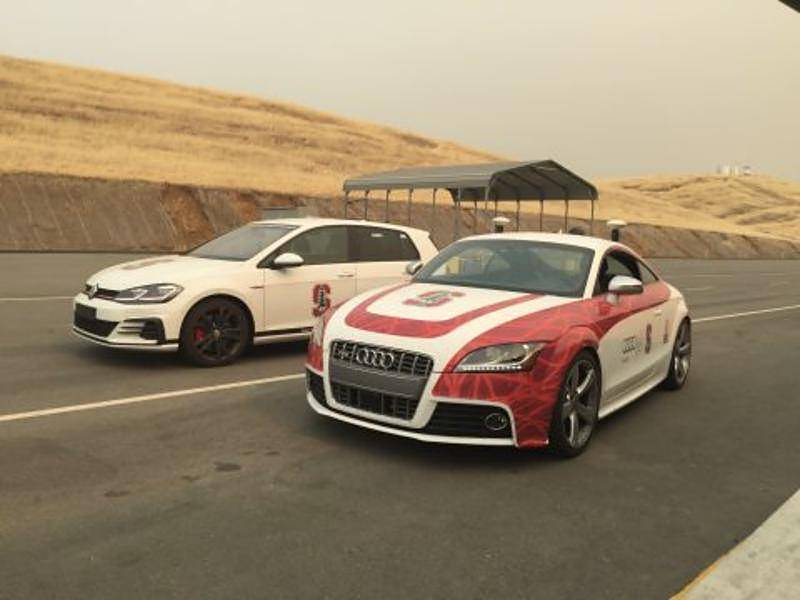
Niki and Shelley, the Dynamic Design Lab's automated Volkswagen GTI and Audi TTS, at the track.
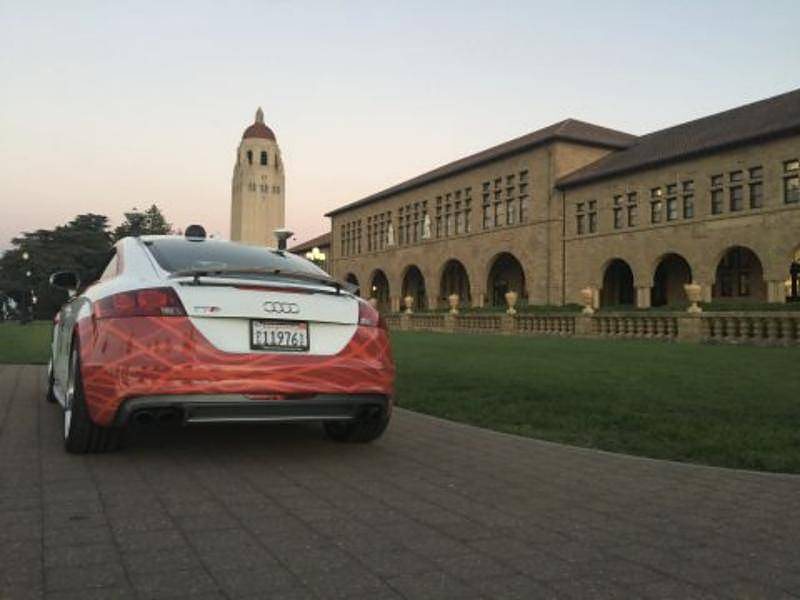
Shelley at Stanford.
Learned vehicle dynamics
Neural network models trained on real driving data predict how a car moves on dry asphalt and on snow, with no explicit friction estimate. In the same controller, on the same car, the learned model beat the physics model.
Science Robotics, 2019 [1]
The racing driver benchmark
A feedforward-feedback controller tracked a path at the friction limit with performance comparable to a champion amateur race car driver.
Science Robotics, 2019 [1]
Learning-based MPC
A neural network model inside model predictive control held a trajectory near the limits on high- and low-friction courses, and outperformed a physics-based MPC benchmark on both.
IEEE TCST, 2021 [2]
Reinforcement learning on a real car
Model-based RL took almost two seconds off a 29-second lap on a full-scale automated race car, and needed only two laps of data on ice.
IEEE OJ-ITS, 2023 [3]
Contingency planning
Plan for what other road users will probably do over a long horizon. Keep a second, shorter plan ready for what they might do instead.
Three patents
Learned simulation and rule-aware selection
LSTM vehicle dynamics simulators for virtual testing, and trajectory selection that scores candidates against safety and behavior rules.
Two patents
“We want our algorithms to be as good as the best skilled drivers.”
N. A. Spielberg, M. Templer, J. Subosits, J. C. Gerdes. Learning policies for automated racing using vehicle model gradients. IEEE Open Journal of Intelligent Transportation Systems 4, 130–142, 2023.
Five patents and published applications in autonomous vehicle planning and control.
Autonomous vehicle with contingency consideration in trajectory realization
US12570328B2Granted March 10, 2026
Trajectory planning that weighs expected traffic behavior against possible contingencies, folding alternative driving corridors into the plan.
Vehicle motion planning with shortened horizon contingency MPC with terminal constraint
PCT/US2026/022357October 8, 2026
Model predictive control with a long horizon for expected behavior and a shorter one for contingencies, closed off by a terminal constraint.
Generating worst case constraints for autonomous vehicle motion planning
US20240253663A1Filed March 10, 2023
Builds constraints for both expected and worst-case behavior by other road users, then uses them to evaluate trajectories and choose control actions.
Machine learning based vehicle dynamic simulator
WO2026136676A2June 25, 2026
LSTM networks that predict vehicle motion from a planned trajectory and an initial state, for virtual testing of driving software.
Trajectory selection and planning based on rule violations
US20260285365A1May 24, 2026
Scores candidate trajectories against behavioral and safety rules, using both the likelihood of a violation and how close the vehicle is to one.
Now
Tamarin AI
Co-founder and CTO. January 2024 to now.
Most procurement AI projects fail on the same thing: dirty, fragmented data. Tamarin fixes the data first. We pull spend out of legacy systems, clean and categorize it line by line, and put agents on top that surface savings a category manager can defend in the boardroom.
I own the technology end to end: the ingestion pipeline, the classification models, the agent workflows, and the engineering team. I build it the way I built safety-critical driving software. Observable pipelines. Measurable outcomes. Fast time to value.
My co-founder, Mary Delaney, spent eight years at McKinsey. We were classmates at MIT.
“Nathan owns all of the technical decisions – it’s 1000% his wheelhouse.”
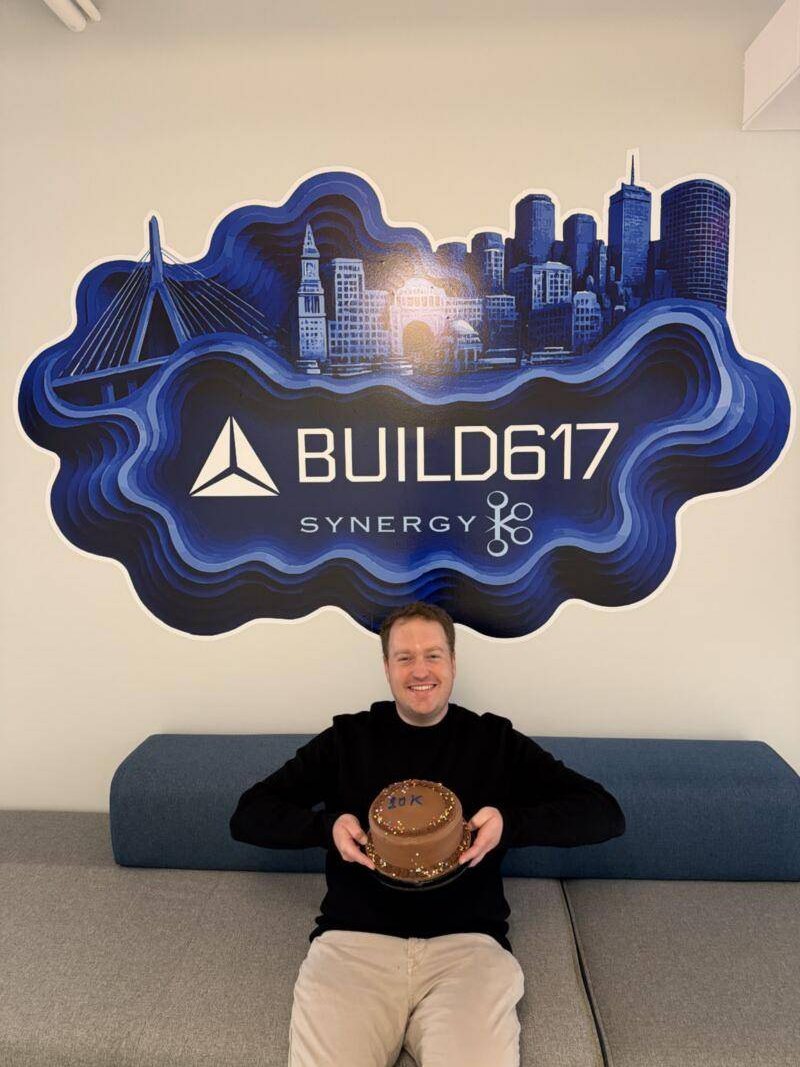
BUILD617
Founder. October 2025 to now.
Boston produces world-class founders and then loses their companies. I got tired of complaining about it and started BUILD617, a founder-led movement with one goal: build and scale three times as many enduring companies here over the next ten years.
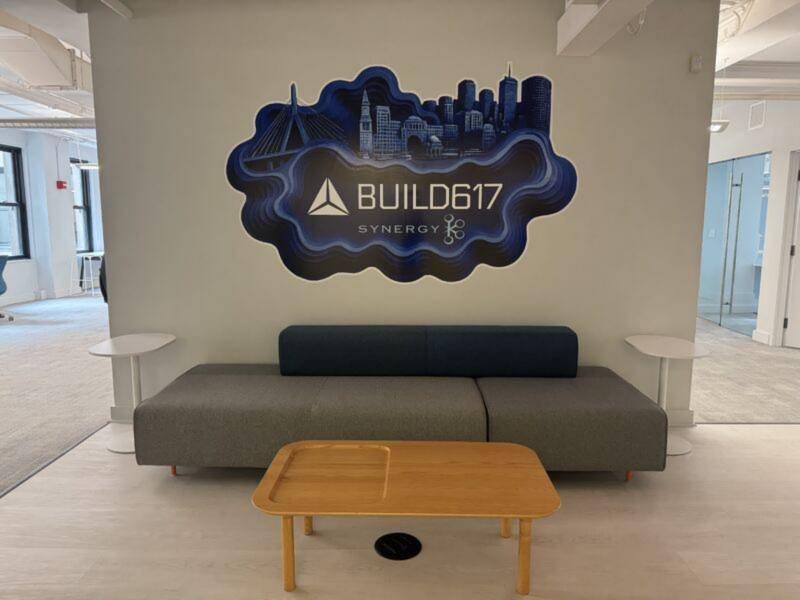
One year in, it is a podcast, a weekly live news show, founder dinners, and BUILD617 HQ, a cobuilding space at 38 Chauncy Street in Downtown Crossing. Synergy provides the space. Selected startups pay nothing. The catch: you show up at least three days a week.
On the pod, Nick Leonard and I have sat down with Helen Greiner of iRobot, Jason Kelly of Ginkgo Bioworks, Eric Paley of Founder Collective, Natan Linder of Tulip and Formlabs, Mike Salguero of ButcherBox, Christopher O'Donnell of Day AI, David Chang of Via AI and Benj Cohen of Proton.ai.
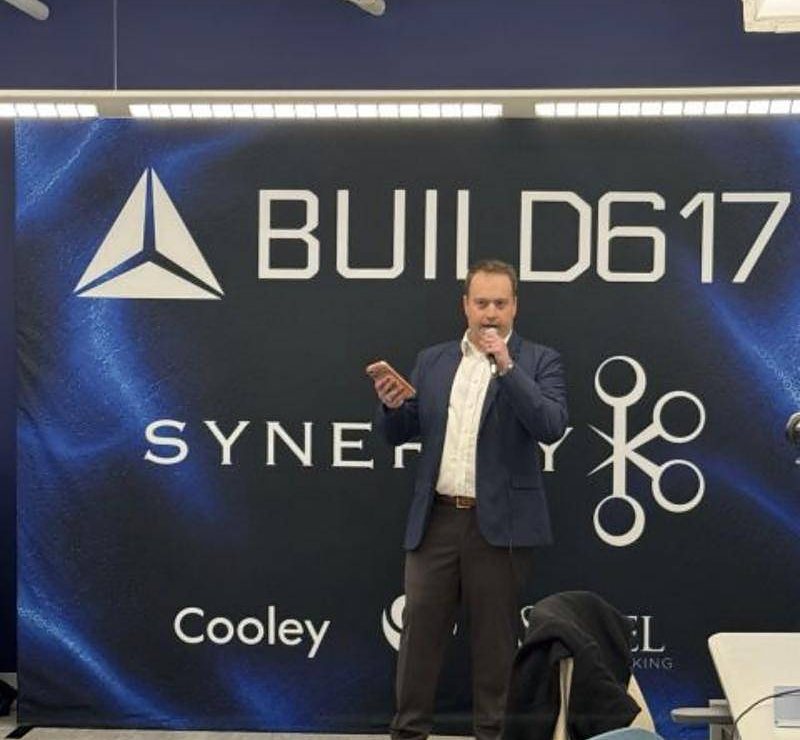
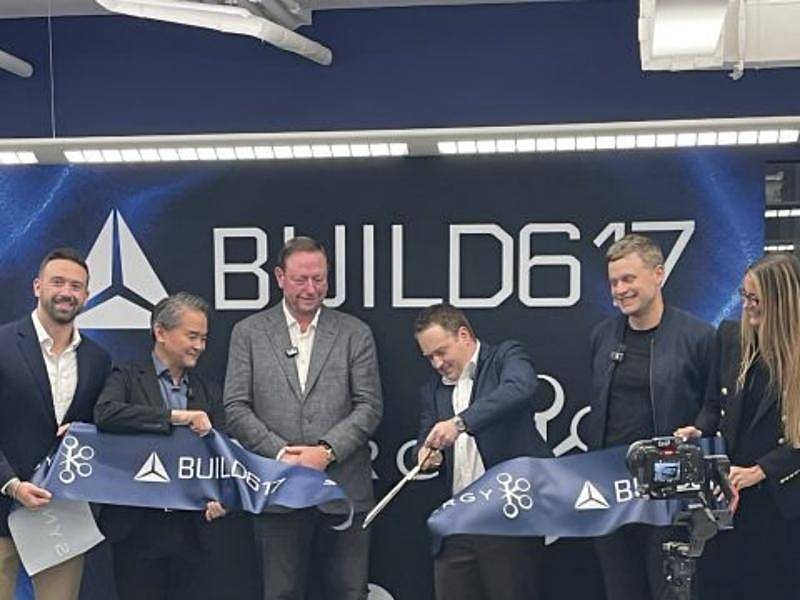
Opening night at BUILD617 HQ, September 2026.
The ribbon cutting.
The studio we built in about a week.
BUILD617 HQ, 38 Chauncy Street.
Before
2021–2023
Motional
Senior machine learning, controls and motion planning engineer.
Conceived, designed and built next-generation trajectory optimization and control for Motional's driverless vehicles on the Lyft and Uber networks, in C++ and Python. My patents are in this line of work: plan for what other road users will probably do, and keep a second, shorter plan ready for what they might do instead.
PhD and MS. Dynamic Design Lab, advised by Chris Gerdes.
Built the learning systems that let full-scale automated race cars drive at the limits of friction. Compared them with skilled human drivers at Thunderhill Raceway, tested on ice near the Arctic Circle, and published the results in Science Robotics.
Funded by an NSF Graduate Research Fellowship and a Stanford Graduate Fellowship. Official lab title: Head Chef.
2014–2015
CoBattery
Co-founder.
Designed an iPhone battery case with swappable batteries from scratch and launched it on Kickstarter. Featured by Kickstarter, 380+ backers, over $60,000 raised. Went to Shenzhen to set up manufacturing.
2011–2015
MIT
S.B. in mechanical engineering, 5.0 out of 5.0.
At the Media Lab, in Neri Oxman's Mediated Matter group, I designed electronics, hardware and controls for the Digital Construction Platform, a boom truck that 3D prints structures the size of buildings. In John Hart's Mechanosynthesis Group, I built an inverse stereolithography system for patterning cells inside microfluidic chips.
Summers at Formlabs, on the Form 1 printer, and at PARC, on multi-material robotic 3D printing. I also built 3D printers in my dorm room.
Before 2011
Louisville, Kentucky
Started building my first guitar at 13. It took eight hours a day, every weekend, for three and a half years. Raised $60,000 for dystonia research by selling silicone bracelets, then spent a high school summer in a lab on the research it funded.
Honors
Stanford
NSF Graduate Research FellowshipNational Science Foundation, 2015
William R. and Sara Hart Kimball Stanford Graduate FellowshipStanford University, 2015
Research spotlightsStanford News, TechCrunch, The Verge and Popular Science, 2019
I started with guitars and never stopped building.
Spielberg Guitars
Head luthier since 2021.
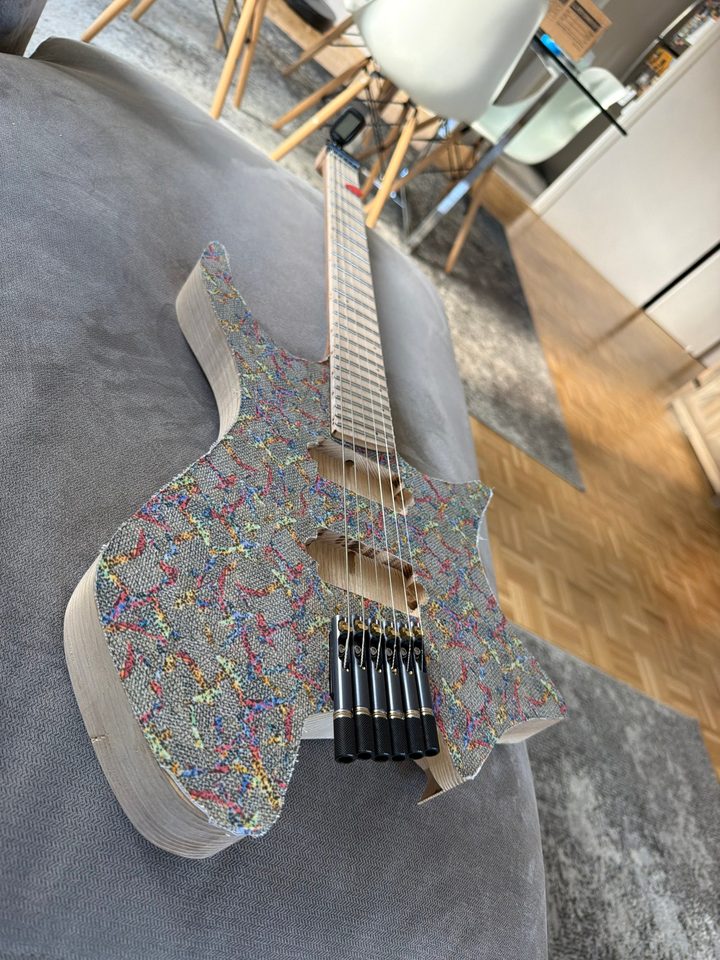
I design and build electric guitars from scratch. On the bench now is the most complex one yet: headless, multiscale with fanned frets, a trapezoid neck, and a separate bridge for every string so each one intonates on its own. It is getting a full MBTA Red Line theme, down to the original seat fabric on the top and back.
Fret layout for a 25.5 to 27 inch multiscale. Every fret sits at scale length × (1 − 2−n/12) from the nut. The two edges of the neck disagree, so the frets fan.